Florida homeowners don’t need a weather report to know the sun here is a different animal. By 10 a.m. in June, a west-facing patio can feel more like a skillet than a place to sit down with coffee. The UV index across Central Florida regularly hits “very high” to “extreme” for most of the year, and that’s not just a comfort problem. It’s a health problem, a furniture problem, and a flooring problem. A patio awning is one of the most effective ways to take that exposure down to something livable, but not every awning does the job equally well. The right patio awning blocks UV rays, holds up to Florida humidity and storms, and keeps doing its job for a decade or more without fading or breaking down. Here’s what actually matters when you’re choosing one.
Why Florida Sun Puts Extra Demands on a Patio Awning
Most parts of the country deal with strong sun for a few months a year. Central Florida deals with it almost year-round. The state sits close enough to the equator that UV exposure stays elevated even in what other regions would call the off-season, and the combination of heat, humidity, and near-daily sun means outdoor furniture, decking, and flooring take a beating faster here than almost anywhere else in the country.
That’s the real argument for a patio awning over other shade options. A patio awning isn’t decorative. It’s functional infrastructure for anyone who wants to actually use their outdoor space between March and October instead of retreating indoors every afternoon. But a poorly made awning, or one built with the wrong fabric, will fade, sag, or lose its UV-blocking properties within a few years under this kind of sun load. That’s why fabric choice matters more here than it does in a milder climate.
Fabric Is What Actually Blocks UV Rays
A lot of homeowners assume any patio awning will block the sun as long as it casts shade. That’s not quite right. Shade reduces direct glare, but UV rays can still pass through thin, low-quality fabric, and reflected UV can bounce off pavers, pools, and light-colored surfaces even under cover. The fabric itself is what determines how much protection you’re actually getting.
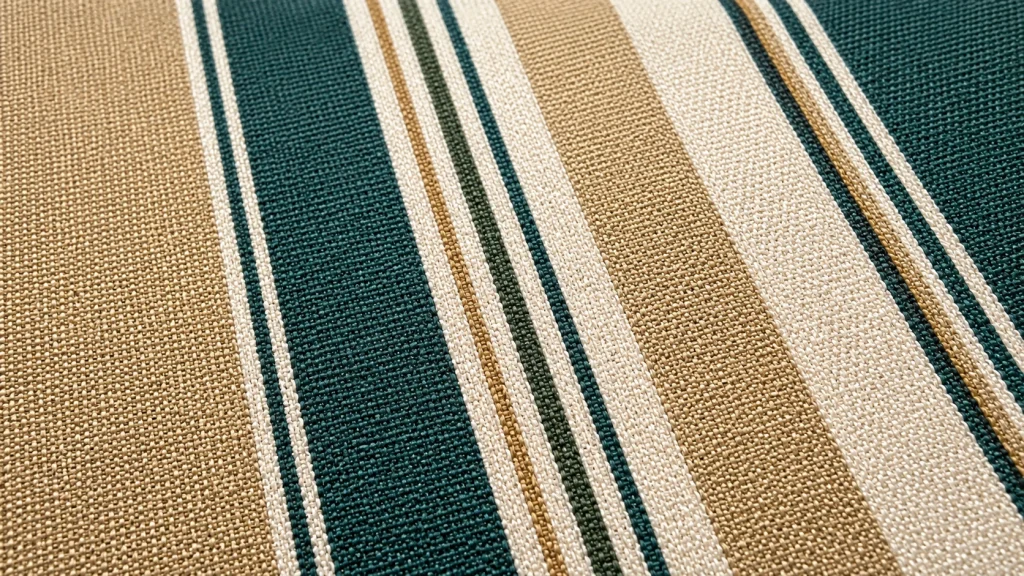
Woven acrylic fabric, the kind used in Sunbrella and similar premium lines, is the standard for a reason. It’s solution-dyed, meaning the color runs through the entire fiber instead of sitting on the surface, so it resists fading even after years of direct sun. It’s also naturally resistant to mildew, which matters in a state where humidity sits above 70% for most of the year. Most importantly, tightly woven acrylic fabrics block a significant percentage of UV radiation, often in the UPF 50+ range, which is roughly equivalent to sunscreen with an SPF of 50.
Polyester and vinyl awning fabrics are cheaper up front but tend to break down faster under intense UV exposure. They can lose color, become brittle, and in some cases lose UV-blocking effectiveness well before the frame or motor shows any wear. For a patio awning that’s going to see Florida sun for ten or fifteen years, fabric quality isn’t a place to cut costs.
Retractable Awnings Give You Control Over Sun Exposure
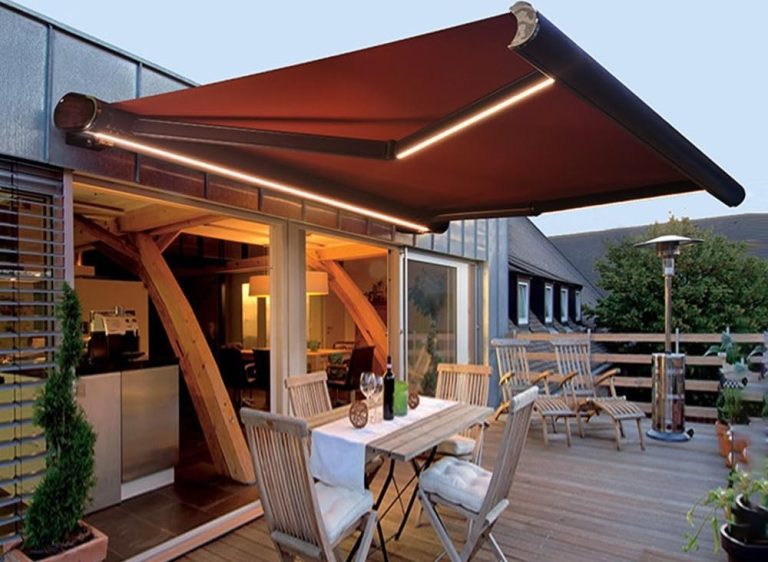
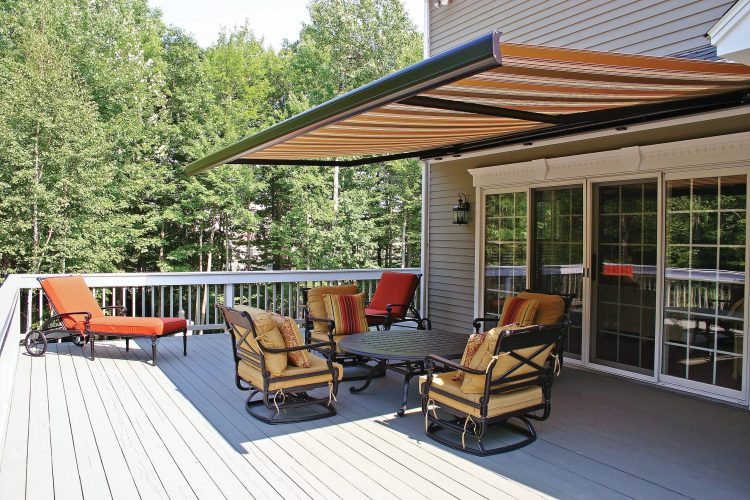
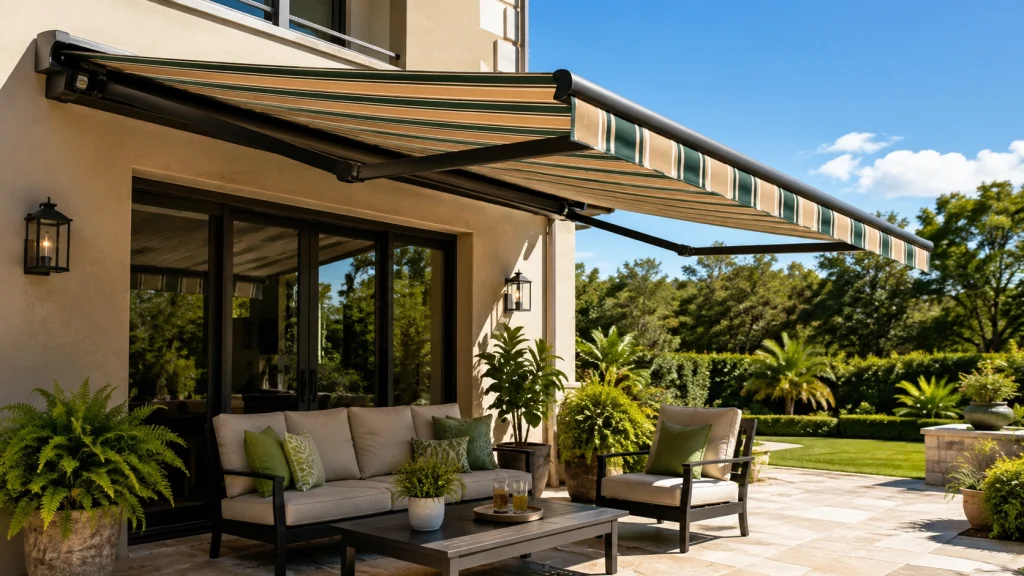
Fixed awnings and pergolas provide shade, but they provide it on a fixed schedule dictated by the structure, not by the sun’s actual position or your actual needs. A retractable patio awning changes that equation. Because the fabric extends and retracts on demand, homeowners can position it for maximum UV blocking during peak sun hours, typically 10 a.m. to 4 p.m., and retract it in the early morning or evening when the angle of the sun is lower and less harmful.
This flexibility also protects the awning itself. Leaving any fabric awning extended and exposed around the clock accelerates wear from UV degradation, wind, and rain. Retracting it when it’s not needed extends the life of the fabric and keeps its UV-blocking performance closer to factory levels for longer. That’s part of why most manufacturers design retractable systems to be used as intended, extended when protection is needed, closed when it isn’t, rather than left open as a permanent fixture.
Motorized retractable awnings take this a step further. Instead of manually cranking a lever, homeowners can extend or retract the awning at the touch of a button, which makes it far more likely the awning actually gets used the way it’s supposed to be used. A manual awning that’s inconvenient to operate often just stays in one position, which defeats some of the purpose of having a retractable system in the first place.
Coverage and Positioning Affect How Much UV Protection You Actually Get
Fabric quality is only part of the equation. How the awning is mounted and how far it projects from the house determines how much of the patio actually gets covered during the hours when the sun is highest and most damaging.
Projection, meaning how far the awning extends outward from the wall, matters more than most homeowners expect. An awning that only projects 8 feet might fully shade a patio during midday but leave large sections exposed in the late afternoon when the sun angle shifts. Homes with larger patios, pool decks, or lanais often need 10 to 12 feet of projection, and in some cases up to 16 feet, to keep the space fully shaded through the hours when UV exposure peaks.
Mounting style also plays a role. Wall-mounted awnings are the most common and typically the most stable option, but they require adequate clearance, usually a minimum of about 7.5 feet, and can be blocked by outswinging doors or windows. In those cases, a roof mount raises the awning high enough to clear obstructions while still achieving the correct pitch for effective sun and rain protection. Getting this measurement right is part of what separates an awning that actually blocks UV rays across the whole patio from one that leaves gaps.
Does Awning Color Affect UV and Heat Protection?
Color is often treated as a purely aesthetic decision, but it does have a small functional role. Darker fabrics tend to absorb more heat, which can make the underside of the awning and the air just beneath it feel slightly warmer on the hottest days. Lighter colors reflect more solar energy and can feel a few degrees cooler underneath, though the difference is generally modest compared to the impact of fabric quality and coverage.
What matters more than color for UV blocking specifically is the density and weave of the fabric. A tightly woven fabric in a darker shade will still outperform a loosely woven fabric in a lighter shade when it comes to actually stopping UV radiation from passing through. Homeowners choosing between color options should feel free to prioritize what matches their home’s exterior, since the UV protection difference between most color choices within the same fabric line is minimal.
Smart Features That Improve Real-World UV Protection
Modern motorized awnings often come with sun sensors, which automatically extend the awning when direct sunlight hits a certain intensity and retract it when clouds roll in or the sun goes down. This solves one of the biggest practical problems with any shade system: people forget to use it. A homeowner who’s out running errands during the hottest part of the day isn’t manually extending an awning before they leave, but a sun sensor handles that automatically, meaning the patio and any furniture underneath stay protected even when nobody’s thinking about it.
Wind sensors serve a related but different purpose. They don’t measure UV exposure directly, but they protect the awning’s ability to keep providing UV protection over the long term by automatically retracting the fabric if movement crosses a certain threshold, reducing the risk of frame or fabric damage during Florida’s sudden afternoon storms.
Front and side drop screens are another option worth considering for homes with a lower sun angle problem, such as west-facing patios that catch harsh late-afternoon sun even when the main awning is extended. These screens drop down from the front edge of the awning to block that low-angle light that a standard awning can miss.
Maintenance Keeps UV Protection at Full Strength
A high-quality patio awning doesn’t lose its UV-blocking ability overnight, but neglect speeds up the process. Dirt, pollen, and debris build up on fabric over time, and while acrylic fabrics resist mildew directly, that buildup creates a surface where mildew can take hold if it’s never rinsed off. Beyond the appearance issue, prolonged dirt buildup can gradually degrade fabric performance.
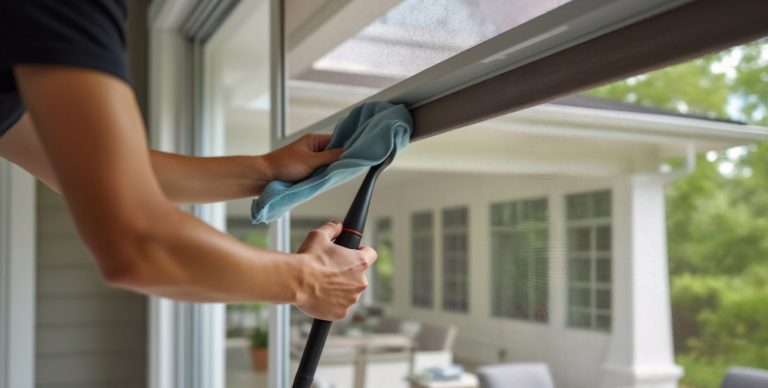
Keeping the fabric rinsed off periodically is typically enough to prevent this. For units that already show mildew staining, anti-mildew fabric cleaners formulated for awning material can usually restore the fabric without damaging the UV-resistant coating. Motors themselves are sealed and generally maintenance-free, though having the arm pivot points lubricated occasionally can help keep the system operating smoothly for its full lifespan, which for most quality fabrics runs 12 to 15 years, with frames and motors often lasting well beyond that.
Choosing the Right Patio Awning for Central Florida Homes
The best patio awning for blocking Florida’s harshest UV rays comes down to a few consistent factors: tightly woven acrylic fabric with a strong UPF rating, adequate projection to cover the full patio during peak sun hours, correct mounting for the home’s layout, and ideally a motorized system with sun sensors to make sure the awning is actually deployed when it’s needed most. Fixed structures and lower-quality fabrics might offer some relief, but for homeowners who want real, consistent UV protection through a Central Florida summer, a properly specified retractable awning is hard to beat.
Ready to see what real UV protection looks like on your own patio? Explore our retractable awning services to find the right fabric, size, and features for your home, or call us at (844) 629-6464 to schedule a free, no-pressure estimate with our team.